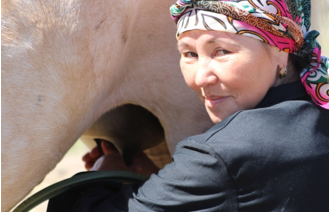
Traditions and customs associated with tying mares, preparing kymyz: - - kymyzmuryndyk - - bie agytu - sirge zhiyar Included in the UNESCO Representative list in 2018.
Tying the mare - milking the mare and fermenting kymyz. Tying a mare is one of the solemn rites of the traditional environment, associated with the work performed during the season of tying the mare and milking kymyz. When people go out to pasture, they begin to separate the milk mares. First, pegs are hammered in to draw a line, the first peg is tied with a white cloth to the handle of a special peg and one of the elders makes a tapping gesture. When stretching lasso, a peg is driven into the middle of every five foals. The area of lasso is called bie bau.
The women carefully wash konek and saba and dry them on lasso. The oil is applied to the mare's three pegs, the top of lasso, the stallion's mane and the mare's udder to bring good luck to the animal.
After this, the foals are tied to the lasso using ropes. Foals being tied for the first time are constantly observed until they learn not to crane their necks. Having tied the foals to the lasso, bie bau tea is prepared. At the front of the line, bie bau tea was made and those gathered ate kurt, bread, сottage cheese, etc. This is called “shashu shai”. All children, young and oldparticipated in shashu shai. Blessings and wishes are pronounced with good intention: “Let the rich increase in number”.
As a festive ritual related to the Kazakh horse, it was inscribed by the decision of UNESCO on the Representative List of the Intangible Cultural Heritage of Humanity (Port Louis, Mauritius, 26 November – 1 December 2018).