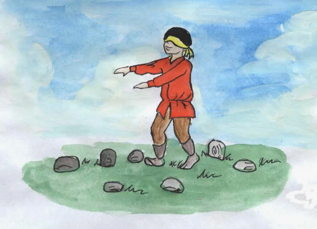
Traditional children's and youth games: - Bes tas - Tympi - Sokyr teke - Ak terek - - Kok terek
Kazakh national games are traditional forms of entertainment from ancient times. The history of the national games that have reached us today dates back to BC in Kazakhstan. It was formed in the 1st millennium. Togyzkumalak, doll, and asyk games are widespread in Asian countries in tribal unions and primitive states. In the process of mastering national games, children and teenagers train their bodies and develop their minds by doing various exercises. The Kazakh nation, in particular, put the care of the offspring as the main goal and paid great attention to the formation of children as real citizens. As a result, national games were coordinated and developed as the main means of traditional child education. This is also evidenced by the presence of several versions of the same game (for example, throwing a belt, throwing a scarf, khan kalay, zhayau kokpar, etc.). The basis of national games in Kazakh society, its origin begins with traditional nomadic economic activities. Most of them are based on animal husbandry, hunting and warfare. The main educational value of the games is to train and specialize the future generation in future professions, that is, they are a branch of traditional national pedagogy (Aigolek, Altybakan, Ak suiek, Sokyr teke, Tayak zhugirtu, korshi, etc.).