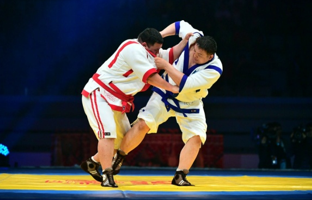
Kazakh kuresi – Kazakh national wrestling. Kazakh kuresi, a kind of national art that has not lost its reputation for many centuries, did not disappear even in Soviet times. Kazakh kuresi developed with a new impetus and became a folk art. One of the features of Kazakh wrestling is that in an upright position, while performing leg movements, attempts are made to grab the opponent's waist with double hands or a specially designed belt, clothing. Technically, there are many different methods of Kazakh wrestling. This is largely similar to modern free and classic wrestling. We can mention such methods as hanging from the legs to the head, throwing over the head, taking on the hips, as well as stretching through the chest with a supine position.
Kazhymukan is a great figure in the Kazakh kuresi. This is due to the fact that in the period before the October Revolution, many countries performed on the sports scene and showed the name of the entire Kazakh people in international competitions.
The names of the Champions of the Soviet Union Amangeldy Absattarov and Abilseit Aikhanov are familiar to everyone. At the First World kurultai of Kazakhs, held in 1992, the first International Wrestling Federation of Kazakh kuresi was established. Since then, Kazakh kuresi have been organized in different years, such tournaments as “Tuiyepaluan” and “Altyn belbeu”. Currently, the tournament “Kazakhstan barysy”, which has been held since 2011, is a great achievement of Kazakh sports. In different years, the winners of this tournament were U. Ryskul, B. Ystybayev, A. Nugymarov and others.
By the decision of UNESCO, Kazakh wrestling was inscribed on the Representative List of the Intangible Cultural Heritage of Humanity (Addis Ababa, Ethiopia, 28 November – 2 December 2016).