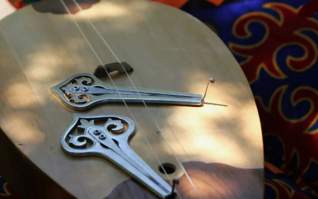
Playing the shankobyz
Shankobyz is the national musical instrument of the Kazakh people. It belongs to the group of stringed musical instruments (performed by the tongue). Earlier, in the Southern regions of the republic, this instrument was called “shankauviz”. Musical instruments can be found in many peoples of the world, except Kazakhs. For example, “homus” (Yakutia), “kubyz” (Bashkurtstan), “munharpa” (Norway), “dan moi” (Vietnam), “doromb” (Hungary), “mukkuri” (Japan), “morchang” (India ), “vargan” (Ukraine), etc. types are found.
There is no specific information about the appearance of Shankobyz. According to various assumptions made by world scientists, shankobyz appeared 9-12 thousand years ago. The ancestor is a bow. According to scientists, people of early times stuck one end of the bow in the ground, touched the other end to their palate or teeth, and made a sound by pulling the string.
The method of performing tunes on this musical instrument is as follows. The instrument is placed between the lips and played while resting on the teeth. For this, the thumb, index finger and middle finger of the left hand hold the instrument. The other two fingers are partially bent and put on the middle finger. The palm is partially closed and makes a cavity and the sound of the instrument collects in that cavity and comes out. The sound of the instrument is produced by the vibration of the spring when the tab is struck with the finger. The strength of the sound is directly related to the space between the lips and the teeth during playing. Also, the performer can make different sounds by moving his tongue.
There are two distinct sounds when playing in shankobyz. The volume of air expands and contracts depending on the degree of movement of the tongue, lips and larynx. “With the presence of the tongue and the larynx, it is possible to produce some amazing sounds that do not even belong to any of the terms currently in use”.