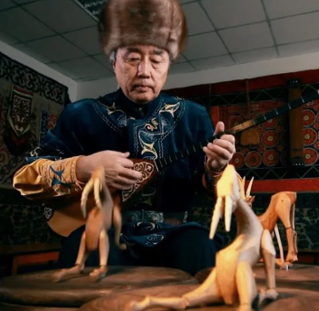
Orteke - traditional performing arts of Kazakhstan: dance, dolls and music Inscribed on the UNESCO Representative List in 2022
Orteke is a wooden toy that moves and dances to the rhythm of a song or kui when playing a dombra. Orteke is created in the image of tauteke. In order to swing and dance, orteke swings when he pulls dombra, the toy is attached vertically to the liver, and the other end is hung on the finger and pulled. In addition to the Kazakh people, this art form can be found in the Kyrgyz, Kalmyk, Afghan, Iranian, Caucasian public.
Orteke's history goes deep. On the one hand, it was seen as a ritual, on the other hand, it was initially used by both older people and children for fun. In ancient times, a person performing a musical instrument played not just one orteke, but about ten toys in a row. This was due to the skill of the performer, a high level of dexterity of the right and left hands. In modern times, the same ortheke playback with both hands has disappeared.
This art form can be attributed to several directions. These are: arts and crafts, music, dance and the art of leading a doll. According to scientists, it has a ritual, mythological and household-symbolic meaning.
Some say the Kazakh puppet theater originated with orteke, but certain differences prevail. In classical puppet theaters, the puppet actor leads the puppets directly himself or herself, in orteke puppetry, the musician conducts the figure or several figures indirectly through the instrument.
The art of “Orteke” was inscribed on the UNESCO Representative List of the Intangible Cultural Heritage in 2022 (Rabat, Morocco, 28 November – 3 December 2022).