Making kobyz
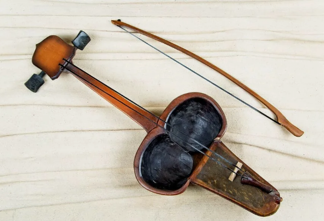
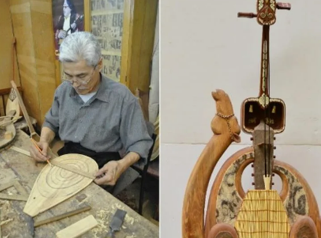 Kobyz is a bowed instrument with two strings. It was hollowed out of one whole wooden piece – juniper (arsha), maple, pine-tree and birch. The instrument consisted of three parts: head (bas), middle (base is keude) and lower part (ayak).
The base is made in the form of an open bowl stretched downside. This lower part of the instrument is covered with leather (sounding board). The support (tiek) is established on it. Even in our days, the strings for kobyz are made of horse-tail.
The bow has an arched shape and it looks like a bow weapon: the bun of horsehair is tied to both ends of the bent branch and fixed by the strong thread of camel wool. The performer enfolds the bow from aside with his hand.
The shaman instrument looked quite strangely: there were owl’s feathers on the head, various metal plates in the form of horn curls and ringing bird images were hanging around the head; the mirror was located on the bottom of the bowl. All these were not just decoration but the shaman signs-symbols.
Kobyz possesses unusually rich and colourful timbre. This professional music art amply reflecting the life of a Kazakh nomad still adheres to its ancient sacral roots that once conceived it. The ancient notions and piety towards the instruments and music was constantly preserved in the traditional Kazakh society providing for the highest spiritual level of music art and a special deferential attitude towards the musical instruments.
Common people, for example, dared not to touch the shaman's kobyz. The balance between the courses of Life and Death on earth can be maintained by playing the kobyz, another musical instrument recounted in the following legend about the first shaman Korkut.
Kobyz is a bowed instrument with two strings. It was hollowed out of one whole wooden piece – juniper (arsha), maple, pine-tree and birch. The instrument consisted of three parts: head (bas), middle (base is keude) and lower part (ayak).
The base is made in the form of an open bowl stretched downside. This lower part of the instrument is covered with leather (sounding board). The support (tiek) is established on it. Even in our days, the strings for kobyz are made of horse-tail.
The bow has an arched shape and it looks like a bow weapon: the bun of horsehair is tied to both ends of the bent branch and fixed by the strong thread of camel wool. The performer enfolds the bow from aside with his hand.
The shaman instrument looked quite strangely: there were owl’s feathers on the head, various metal plates in the form of horn curls and ringing bird images were hanging around the head; the mirror was located on the bottom of the bowl. All these were not just decoration but the shaman signs-symbols.
Kobyz possesses unusually rich and colourful timbre. This professional music art amply reflecting the life of a Kazakh nomad still adheres to its ancient sacral roots that once conceived it. The ancient notions and piety towards the instruments and music was constantly preserved in the traditional Kazakh society providing for the highest spiritual level of music art and a special deferential attitude towards the musical instruments.
Common people, for example, dared not to touch the shaman's kobyz. The balance between the courses of Life and Death on earth can be maintained by playing the kobyz, another musical instrument recounted in the following legend about the first shaman Korkut.